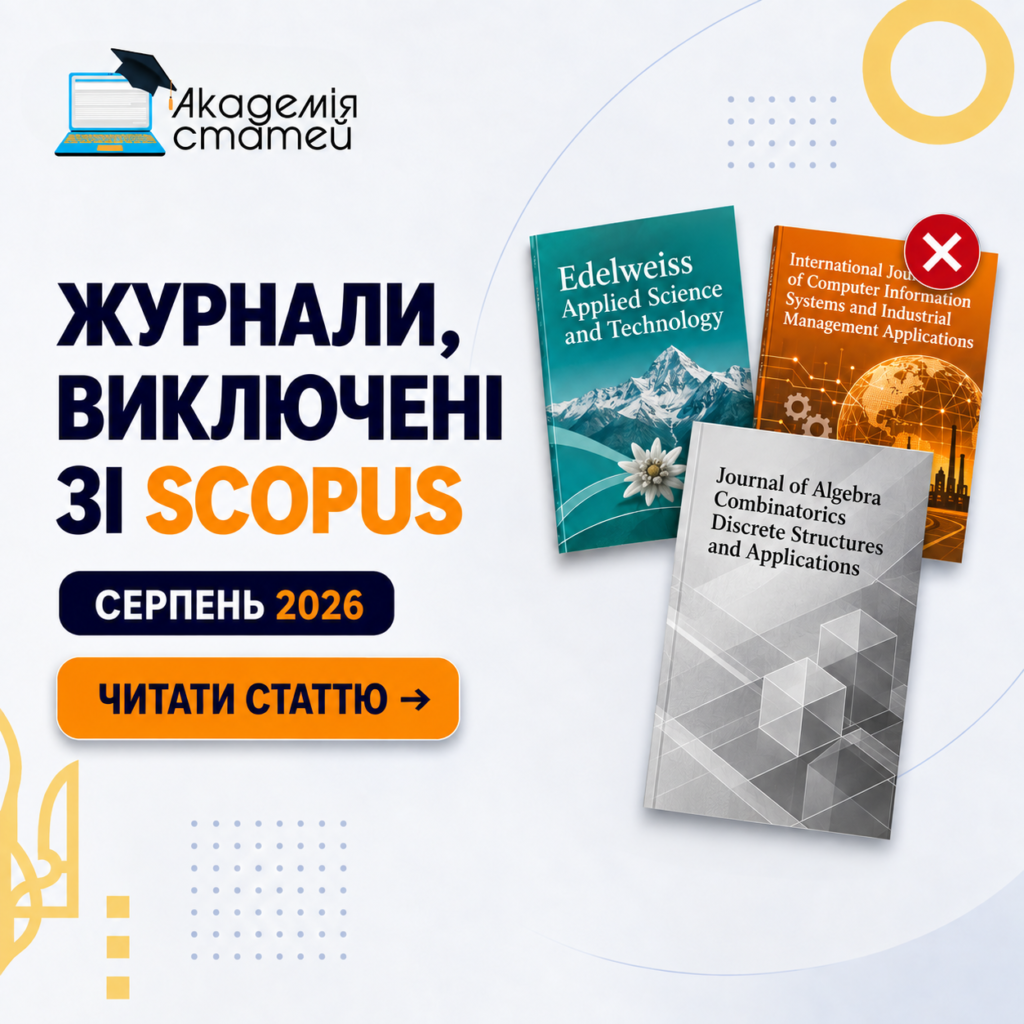
Ukraine lost 10 Scopus-indexed journals—and this served as one of the catalysts for systemic changes. Category B 2026 took over a year to take shape: as early as the beginning of 2025, the Ministry of Education and Science stopped accepting new journals into the list. Then Order No. 56 was issued, setting out new requirements for publications. This was followed by a long wait for the selection results. And it wasn’t until June 2026 that the new list was published.
For over a year, the academic community lived in uncertainty: would the journal continue to exist, would I be able to get my work published in time, and would the publication be accepted as part of my thesis defense?
But amid all these questions, one remained unasked: Why did this happen in the first place? What prompted the Ministry of Education and Science to shut down the system, rewrite the rules, and launch a large-scale selection process?
In this article, we’ll discuss exactly that: what led up to the reform, what events accompanied it, and what strategic logic lies behind it. The answer doesn’t begin in 2026—or even with an order.
Background: A Smoldering Fire
The system of Category “B” professional journals existed for more than ten years with virtually no structural changes. During this time, some journals moved toward higher quality: they strengthened their peer-review processes, recruited international editorial board members, and aligned themselves with global standards. Others moved in the opposite direction: they increased the number of articles per issue and simplified editorial procedures.
The Ministry of Education and Science responded on a case-by-case basis: it removed individual journals from the list, issued recommendations, and conducted inspections. There was no systematic response at the regulatory level.
At the same time, the ministry was moving forward in a strategic direction. From 2024 to 2025, the Ministry of Education and Science conducted training sessions for universities and journal editors on how to prepare publications for submission to Scopus and Web of Science, what the requirements are, and how the selection process works. The goal is simple yet ambitious: to increase the number of Ukrainian journals in international databases. This is not just a matter of science, but also of the country’s reputation on the international stage.
The fire smoldered. The events of 2024 sparked public outcry.
Resonance: Uzhhorod Herald
The history of the *Scientific Bulletin of Uzhhorod National University: Physics Series* is described in an article published by RIO News (the Transcarpathian weekly *R.I.O.*): Scandal at UzhNU: Signs of Corruption Surrounding the University's Academic Journal Have Been Discovered. According to the publication, the journal was indexed in Scopus in 2023, and by 2024, two issues—No. 55 and No. 56—had been published, each with a page count of over 2,000.
According to RIO News, these issues contained articles that did not fit the journal’s academic focus, and their authors were predominantly researchers from Kazakhstan. The publication reports that these issues were not reviewed by the editorial board or the Academic Council of the Faculty of Physics and were not peer-reviewed. Subsequently, the Bulletin was removed from the List of Scientific Publications of Ukraine. RIO News is calling on law enforcement agencies to conduct an investigation.
According to RIO News, these two issues each had a page count of over 2,000, which is several times the usual length of an issue of this publication.
We are not listing the names of those involved in the events: they are mentioned in the RIO News article, but are not relevant to our story.
To understand the background, we need to go back to October 2022. It was then that Memorandum No. 119 was signed between Scientific Publications LLC and Uzhhorod National University. Its purpose was to promote the university’s journals in international scientometric databases, including Scopus.
Next, it is worth taking a look at the Kazakhstani market. The company publicly offered Kazakhstani researchers services to assist with publications in Scopus-indexed journals. For Kazakhstani students pursuing academic degrees, this is not a matter of choice but a requirement: without a publication in an indexed journal, they are not allowed to defend their dissertation. Demand was steady and high.
Fulfilling these obligations is objectively more difficult than selling them. Scopus-indexed journals have waiting lists, quality requirements, and lengthy peer-review processes.
In public reviews on the 2GIS platform, the company’s customers describe prolonged delays and failure to fulfill agreements. We present these as the reviewers’ opinions, not as established facts:
It is also important to take into account the requirements of Kazakhstani law. To defend a dissertation, the candidate must have a publication in their field of study. An article by an educator published in a physics journal, regardless of the journal’s indexing status, may not be accepted toward the defense. In other words, even if the journal is included in the database, some authors may not have achieved the expected result.
For Uzhhorod University, the situation had reputational consequences. The university signed Memorandum No. 119, and subsequently its journal found itself at the center of a public debate on academic integrity. This illustrates a connection between the events, but does not imply that the university acted in bad faith.
International and National Levels
The Uzhhorod Bulletin was a high-profile incident, but it was not the only one. While the situation with the print magazine was being discussed in Ukraine, international organizations were already conducting their own investigations.
Back in 2022, researcher Anna Abalkina of the Free University of Berlin described a network linked to the publication of more than 1,500 scientific articles in dozens of international journals. The red flags she highlighted included email domains that did not match the authors’ official affiliations, anomalous cross-citations, and articles that formally met the journals’ requirements but raised questions about their scientific novelty. The investigation was co-authored with Springer Nature and drew the attention of the journal *Nature*.
On May 22, 2025, the Ministry of Education and Science of Ukraine received a letter from the Directory of Open Access Journals (DOAJ). Based on the results of an internal investigation conducted in March and April 2025, DOAJ removed nine Ukrainian scientific journals due to identified ties to the “Scientific Journals” publishing house (Scientific Journals Publishing House). In the letter, DOAJ explicitly states that this publishing house is also known as “Scientific Alliance” and “Scientific Publications.” The full text of the letter to the Ministry of Education and Science, along with the attachment from DOAJ: Letter from the Ministry of Education and Science dated June 2, 2025, No. 1/11385-25.
DOAJ lists the following signs of misconduct: guaranteed publication in journals indexed in Scopus and Web of Science without following proper peer-review procedures; fabrication of authorship and ghostwriting; citation manipulation; ties to a network of “article mills” in Eastern Europe and Central Asia.
DOAJ has imposed an embargo on the founders of the excluded journals: they may not submit new applications until they sever ties with such partners and file an appeal.
Position of the Ministry of Education and Science
On June 2, 2025, the Ministry of Education and Science of Ukraine issued Letter No. 1/11385-25 “Regarding Clarifications on Cooperation with Organizations That Exhibit Characteristics of ‘Article Mills’”, addressed to the heads of higher education institutions and research organizations, signed by Deputy Minister Denis Kurbatov. The document’s position is unequivocal: signing memorandums between such organizations and educational institutions is incompatible with the principles of academic integrity and contradicts the laws “On Education,” “On Higher Education,” and “On Scientific and Scientific-Technical Activities.” According to data available to the Ministry of Education and Science, as of June 2025, the signatories of such memorandums included 48 higher education institutions in Ukraine, 5 research institutions, and several academies. Deadline for providing explanations and terminating cooperation: June 10, 2025.
The Ministry of Education and Science's position was upheld by three courts
In July 2025, Scientific Publications LLC filed a lawsuit against the Ministry of Education and Science of Ukraine seeking protection of its business reputation and a retraction of false information; Case No. 910/8584/25.
The claims in the lawsuit were as follows:
to declare as false and damaging to the business reputation of “Scientific Publications” LLC, the information disseminated by the Ministry of Education and Science of Ukraine in its letter dated June 2, 2025, No. 1/11385-25, in the form of factual assertions that “Scientific Publications” LLC is an “article mill”;
To order the Ministry of Education and Science of Ukraine, within one month from the date the court decision takes legal effect, to refute the false information that has been disseminated regarding “Scientific Publications” LLC by withdrawing its letter dated June 2, 2025 No. 1/11385-25.
In other words, the plaintiff demanded that the Ministry of Education and Science rescind its own letter to institutions of higher education.
By a decision of the Kyiv Commercial Court dated November 26, 2025, the claim was dismissed. The court of first instance noted, in particular, that the letter from the Ministry of Education and Science did not contain any identifying information about the plaintiff—such as the EDRPOU code, address, or other details—that would allow the court to determine that the case specifically concerned “Scientific Publications” LLC.
By a ruling of the Northern Commercial Court of Appeals dated March 4, 2026, the decision was upheld. The appellate court found that the DOAJ’s conclusion regarding the plaintiff’s connection to the activities of a “paper mill” was an evaluative judgment, and that the Ministry of Education and Science had, in fact, merely taken into account and reproduced the information provided to it by the international organization. The court did not find that the Ministry’s actions constituted a violation of the law.
By a ruling of the Supreme Court, sitting as a panel of judges of the Commercial Court of Cassation, dated May 20, 2026, the cassation appeal filed by Scientific Publications LLC was dismissed, and the decisions of the lower courts were upheld. The ruling is final and not subject to appeal: Full text of the Supreme Court's ruling in Case No. 910/8584/25.
Separately, the case file notes that during June 2025, following a letter from the Ministry of Education and Science, eleven higher education institutions and research organizations—including the Western Ukrainian National University, the State Tax University, Podillia State University, V. G. Korolenko, the National Academy of Culture and Arts Management, Vinnytsia National Technical University, Odesa National Economic University, Cherkasy State Technological University, and Ivan Ohienko Kamianets-Podilskyi National University.
Ukraine Has Lost 10 Scopus Journals: The Complete List
Separate from the DOAJ decision, a number of Ukrainian journals were removed from the Scopus database. These are two different lists and two different decisions by different organizations, so we are listing them separately. According to the data we have, the following journals were removed from Scopus:
- Animal Science and Food TechnologyNational University of Life and Environmental Sciences of Ukraine. ISSN: 2706-8331
- Architectural StudiesLviv Polytechnic National University. ISSN: 2411-801X
- Economics of DevelopmentSimon Kuznets Kharkiv National University of Economics. ISSN: 1683-1942
- APK EconomicsNational Scientific Center Institute of Agricultural Economics
- Machinery and EnergyNational University of Life and Environmental Sciences of Ukraine. ISSN: 2663-1334
- Scientific Bulletin of Mukachevo State University. Economics SeriesMukachevo State University
- Scientific HorizonsPolyssia National University
- Social and Legal StudiosLviv State University of Internal Affairs. ISSN: 2617-4162
- Ukrainian Journal of Forest and Wood ScienceNational University of Life and Environmental Sciences of Ukraine. ISSN: 2664-4452
- Ukrainian Journal of Veterinary SciencesNational University of Life and Environmental Sciences of Ukraine. ISSN: 2663-967X
For a country seeking to integrate into the global scientific community, this served as a signal that piecemeal responses no longer work.
There are two reasons for Order No. 56, not just one
On January 19, 2026, the Ministry of Education and Science signed Order No. 56, a new procedure for compiling the list of scientific journals. The “B” category system was effectively relaunched: a points-based selection system, limits on the number of new publications, annual monitoring, and requirements regarding the editorial board’s composition and transparency.
Most commentators attributed this to a reaction to high-profile cases. That's part of the picture, but not the whole story.
First reason: reactive
The situation with the *Uzhhorod Bulletin*, the DOAJ review, and the Ministry of Education and Science’s letter to universities. All of this has shown that isolated measures do not produce a systemic effect. Excluding a single journal does not solve the problem if the same model is replicated in other publications. Structural rules were needed.
Order No. 56 eliminates precisely these possibilities. Limiting the number of publications to 50% per year makes it impossible to publish hundreds of articles at once. The requirements for the editorial board’s composition complicate the formal management of the journal. Annual monitoring means that the journal cannot “hide” after being included in the list.
The second reason: strategic
At the same time, the ministry was pursuing another goal: to increase the number of Ukrainian journals indexed in Scopus and Web of Science. A country’s presence in international databases reflects its reputation, visibility, and competitiveness in the global scientific arena.
The logic is simple. If Category “B” continues to include journals with a strong editorial board, transparent processes, and genuine peer review, some of them will have a chance of being indexed in Scopus and WoS. A journal with 200 articles per issue will not be included in an international database. A journal with 30 high-quality articles, international editorial board members, and a DOI for each publication might be.
That is precisely why, as early as 2024 and 2025, the Ministry of Education and Science conducted training sessions for universities and editors. Order No. 56 and these training sessions serve a single purpose: to elevate Ukrainian science to a level where it will be recognized by the world.
What does this mean for a researcher, and what should be done next?
The reform of Category “B” is not a one-time event. It marks the beginning of a new reality in which every Ukrainian researcher will have to work.
Monitoring is a constant risk factor for weak journals
The 1,298 journals on the new list are not the final number. The Ministry of Education and Science has introduced annual monitoring and announced the criteria under which journals may be excluded: exceeding the permitted increase in publications, violations of academic integrity, and non-compliance with editorial board composition requirements. We’ve provided a detailed analysis of how the monitoring works and what signs to look for to identify a high-risk publication in a separate article: Category B Journals 2026–2029: How to Choose a Publication That Won't Be Dropped Next Time.
For a researcher, this means one thing: a journal that is on the list today may be removed from it by the date of your defense. And then the publication will not count, regardless of how much time and money you’ve invested in it.
We've broken down exactly what has changed in the new list and how the points were distributed among the publications here: Category B 2026: The list has been updated—what has changed and what this means for publications.
Three Rules for Safe Publishing in the New Reality
First: Check the journal’s scores in the Ministry of Education and Science’s new list. Based on our observations, journals with higher scores have a greater margin of safety until the next monitoring cycle.
Second: Pay attention to journals that have sharply increased their number of publications since the reform. This may be a sign that the journal is overwhelmed and unable to process submissions to a high standard.
Third: submit your work well in advance. Based on our observations, the backlogs at editorial offices are growing, and the closer you get to the defense deadline, the fewer options you’ll have.
Conclusion
Order No. 56 is not based on some bureaucratic whim, but on a specific chronology of events: a memorandum with Uzhhorod University; two issues of a physics journal published without peer review; Kazakhstani researchers who, according to them, did not receive the expected results. An investigation by DOAJ and publications in the international scientific press. An official letter from the Ministry of Education and Science to institutions of higher education. Judicial confirmation of the Ministry’s right to warn of such risks.
The Ministry of Education and Science responded in a systematic manner, as isolated measures had run their course. At the same time, it took a step toward its strategic goal: to elevate Ukrainian science to a level where it will be recognized by the international community.
The reform is just beginning. Annual monitoring, new requirements, and ongoing selection are the new norm. And in this new norm, those who understand the rules and act proactively will come out on top.
Sources
- RIO News. Scandal at UzhNU over the university's academic journal, September 22, 2025
- Letter from the Ministry of Education and Science of Ukraine dated June 2, 2025, No. 1/11385-25, with an attachment and a letter from DOAJ
- Supreme Court Ruling of May 20, 2026, in Case No. 910/8584/25, Scientific Publications, LLC v. the Ministry of Education and Science
- Order No. 56 of the Ministry of Education and Science dated January 19, 2026, Procedure for Compiling a List of Scientific and Professional Publications